
If police seize your phone during an Oklahoma arrest, taking the device does not automatically give officers authority to search everything stored on it. Under the Fourth Amendment and the U.S. Supreme Court decision in Riley v. California, police generally need a search warrant, valid consent, or another recognized legal exception before searching the digital contents of a phone.
Murray Law Firm represents people facing criminal charges in Stillwater, Oklahoma, and nearby areas. An attorney can review how your phone was seized, whether officers had lawful authority to search it, and whether investigators stayed within the permitted scope of that authority.
The key distinction is between seizure and search. Police may be able to take physical possession of a phone during a lawful arrest and secure it as evidence. Opening messages, photographs, applications, location history, account information, or other digital data raises separate Fourth Amendment questions.
Police taking your phone and police searching your phone are separate legal issues. A lawful seizure does not automatically authorize a digital search.
Why Police May Take Your Phone After an Arrest 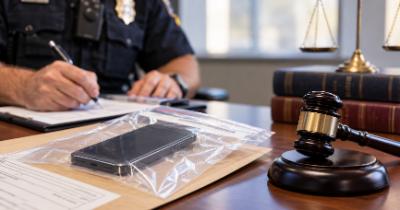
A phone can become evidence in many criminal investigations. Officers may believe that it contains communications, photographs, videos, location information, account activity, or other data connected to an alleged offense. A phone may also be taken because officers find it on the person being arrested and need to secure personal property during booking.
Situations in which investigators may view a phone as potential evidence include allegations involving:
- Drug distribution
• Assault
• Domestic violence
• Theft
• Fraud
• Stalking
• Solicitation
• Conspiracy
The fact that police physically possess your phone does not answer whether they may search its digital contents. A criminal defense review should separate those questions and examine the legal basis for both actions.
For more information about probable cause and police searches, visit https://www.jvmlaw.com/probable-cause/.
Oklahoma Attorney Oklahoma Attorney
James V. Murray

Spencer Allred, Esq.
Can Police Search Your Phone Just Because You Were Arrested?
Usually, no. A lawful arrest allows officers to conduct certain searches associated with the arrest, but the rule is different for digital information stored on a cell phone.
In Riley v. California, the U.S. Supreme Court held that police generally may not search digital information on a cell phone under the ordinary search-incident-to-arrest exception. The Court recognized that modern phones can hold extensive private information and concluded that officers generally must obtain a warrant before searching a phone seized incident to arrest.
A warrant is not the only possible basis for a search. Police may also rely on valid consent or another recognized exception to the warrant requirement. For example, exigent circumstances can justify immediate action in a particular case when officers face a genuine emergency. Whether an exception applies depends on the facts that existed at the time.
If an officer asks for permission to search your phone, consent is a separate legal issue from the officer physically possessing the device. You do not have to volunteer consent simply because your phone has already been seized.
What Happens to the Phone While Police Seek a Warrant?
After police seize a phone, officers may secure it while investigators determine whether to seek a search warrant. The U.S. Supreme Court has recognized that officers may take reasonable steps to preserve a phone while pursuing lawful authority to search it.
Investigators may attempt to prevent the phone from connecting to cellular or wireless networks so that data is not changed or erased remotely. The device may then be stored as evidence while a detective, prosecutor, or other investigator prepares or reviews a warrant application.
A warrant application generally must establish probable cause to believe that evidence connected to a crime will be found in the place to be searched. The Fourth Amendment also requires warrants to describe with particularity the place to be searched and the persons or things to be seized.
For a phone, the wording of the warrant can become important. A warrant seeking threatening messages from a defined period may present different scope questions from a warrant seeking photographs, location information, financial records, or evidence relating to an alleged conspiracy.
Mr. Murray and his team were very professional and helpful throughout this process. As my case was very unique, I knew I was going to need a very specific and special team to help me through this. My wife and I prayed about it and God led us to Murray Law Firm. During the first consultation I requested he pray with me about it and he was quick to agree and that is when I knew we had made the right decision. They went above and beyond our expectations and won the case. I would highly recommend this firm.” - Roger Buchanan The Murray Law Firm worked wonders for me and my needs. James Murray along with his staff are so helpful, understanding, and answered all my questions and concerns. James was able to work his magic and get things done in such a timely manner. James even made his self available by phone after hours when I was in such need. He put not only mine but my whole families worries and concerns at ease. Would highly recommend James Murray to anyone searching for a very good attorney!" - Tiara Rich Jamie is personal yet professional. He can put you at ease and make you feel safe and secure. He will be at your side through this most difficult time in your life and will keep you informed about what is going on in your case and what you can expect. His staff is always ready and willing to do everything the can to help you. Highly recommended." - Alicia Mayfield
What Data Can Police Look for on a Seized Phone?
If police obtain lawful authority to search the device, investigators may attempt to collect data such as:
- Text messages and messages from communication applications
• Photographs and videos
• Call logs and contact information
• Location history and mapping data
• Browser history and internet searches
• Social media communications
• Notes, calendars, and voice recordings
• Payment application activity
• Files stored on the device
• Certain deleted or recoverable data
• Information associated with synchronized or cloud-based accounts
A forensic extraction can produce more information than you see during ordinary use of the device. Investigators may use forensic tools to copy available data, organize records by date or application, and prepare reports for further review.
Digital evidence still needs context. A message may be sarcastic, incomplete, forwarded, or part of a longer conversation. A photograph may have been sent by someone else. More than one person may have used the same device. Location information may indicate where a phone was located without proving who possessed it at a specific moment.
Those details can matter when the prosecution tries to connect digital evidence to a particular person, event, or allegation.
Criminal Defense Case Results
Can Police Make You Unlock the Phone?
Questions about passcodes, fingerprints, facial recognition, and compelled unlocking can involve both Fourth Amendment and Fifth Amendment issues. Courts do not necessarily treat every method of unlocking a phone the same way, and the legal analysis can depend on the type of access requested, the wording of any court order, and what the government already knows.
You do not have to volunteer consent merely because an officer asks you to unlock a device. You can state clearly that you do not consent to a search and that you want to speak with an attorney before answering questions or voluntarily providing access.
Do not physically resist officers, attempt to grab the phone back, or interfere with the seizure. State your position clearly and allow your attorney to challenge the search through the legal process when appropriate.
Can Police Get Your Data Without Searching the Phone Itself?
Sometimes. The physical phone is only one possible source of digital evidence.
Investigators may seek records from:
- Cellular carriers
• Cloud-storage providers
• Social media companies
• Email providers
• Financial applications
• Other online services
The legal procedure depends on the type of information sought and the circumstances. This means that police may obtain some account or provider records without conducting a forensic search of the physical handset itself.
A defense attorney may need to review more than the phone. Relevant materials can include warrant affidavits, provider returns, account records, extraction reports, property records, and chain-of-custody documentation.
How Long Can Police Keep a Seized Phone?
There is no single timeline that resolves every Oklahoma criminal case. A phone may remain in evidence while investigators complete a forensic examination, while charges are pending, or while prosecutors maintain that the device is still needed as evidence.
In some cases, investigators can preserve a copy of relevant data while the owner seeks return of the physical device. In other cases, the prosecution may oppose release because it considers the phone itself to have evidentiary value.
An attorney can contact the appropriate law enforcement agency or prosecutor, determine the status of the device, and evaluate whether requesting its return is appropriate. The answer may depend on which agency seized the phone, where the case is pending, whether the investigation remains active, and whether the physical device is still needed.
What Should You Do After Police Seize Your Phone?
Your goal is to protect your rights without creating another legal problem.
- Do not consent to a digital search if you do not want to give permission.
• Ask to speak with a lawyer before voluntarily providing a passcode or unlocking the device.
• Do not remotely erase, alter, hide, or destroy data.
• Do not ask another person to delete messages, change accounts, or destroy evidence.
• Keep any property receipt, search warrant, inventory sheet, charging document, or release paperwork.
• Write down what officers asked, what you said, whether the phone was locked, and whether anyone else had access to it.
• Avoid discussing the allegations through social media, text messages, recorded jail calls, or other channels that may create additional evidence.
If you are an Oklahoma State University student, an arrest can also create separate university conduct concerns. Learn more about OSU student conduct matters at https://www.jvmlaw.com/osu-student-conduct-offense/.
How a Stillwater Criminal Defense Attorney Can Review a Phone Search
A phone search can raise several legal and evidentiary questions. A defense attorney may review:
- How police obtained the device
• Whether the initial seizure was lawful
• Whether a warrant was supported by probable cause
• Whether the warrant described the requested evidence with enough specificity
• Whether investigators stayed within the authorized scope of the warrant
• Who owned or controlled the phone
• Whether another person had access to the device or accounts
• How investigators extracted the data
• Whether timestamps, account information, or location records are reliable
• Whether the prosecution can authenticate the evidence it wants to use
• Whether the chain of custody creates any evidentiary issue
If evidence was obtained through an unlawful search, a defense attorney may consider asking the court to suppress it. Suppression is not automatic. The outcome depends on the facts, the warrant, the actions of law enforcement, and the legal rules that apply to the case.
You can learn more about attorney James V. Murray and his approach to representation at https://www.jvmlaw.com/our-team/attorney-james-murray/.
Talk With a Stillwater Criminal Defense Attorney About Your Seized Phone
If police seized your phone during an arrest in Stillwater, Oklahoma, or a nearby area, Murray Law Firm can review the seizure, any search warrant, the scope of the search, and the digital evidence that prosecutors may try to use. A careful review can help identify which constitutional and evidentiary issues deserve attention before you make major decisions about your case.
Murray Law Firm offers consultations for people who need to discuss criminal charges and related search issues. Call 405-338-7899 or visit https://www.jvmlaw.com/contact-us/ to request a consultation.
This article is for informational purposes only and does not constitute legal advice. Consult an attorney about your specific situation.

